
Shipping a scale model
abroad
A model travels safely when it is built to travel: a base that splits into sections sized for the crate, loose parts packed separately, and a plywood crate cushioned on every side. It goes by FedEx or DHL, door to door in under a week, and the courier clears customs for you. Sea freight takes six to seven weeks.
Courier or sea
| Route | Time in transit | Suits | Customs |
|---|---|---|---|
| Courier, door to door | Under a week | Almost every model. This is how we send by default, with FedEx or DHL. | Cleared by the courier as part of the delivery. |
| Sea freight | Six to seven weeks (45 to 50 days) | Very large models, when the launch date allows the wait. | Cleared at the port by a freight agent. |
Times are transit only. When to order plans the whole commission back from your date, workshop holidays included.
How size becomes
freight weight
Couriers charge by weight, but a model is light for its size. So they calculate a volume weight and charge whichever is greater. The rule is the same at every major courier: length × width × height of the crate in centimetres, divided by 5000, gives the weight in kilograms.
This is why the base decides the freight. A building is compact; the landscape around it is not. A model with wide surroundings needs a wide crate, and a wide crate is mostly air. If the freight matters, the first question is how much of the site the model has to show. The scale calculator gives the size of the model before anything is drawn.
A base that would not fit a sensible crate is built in sections. We regularly split a base in two for transport. The join is planned along a road or a plot line, so it disappears when the sections meet on the table.
Built to be dropped
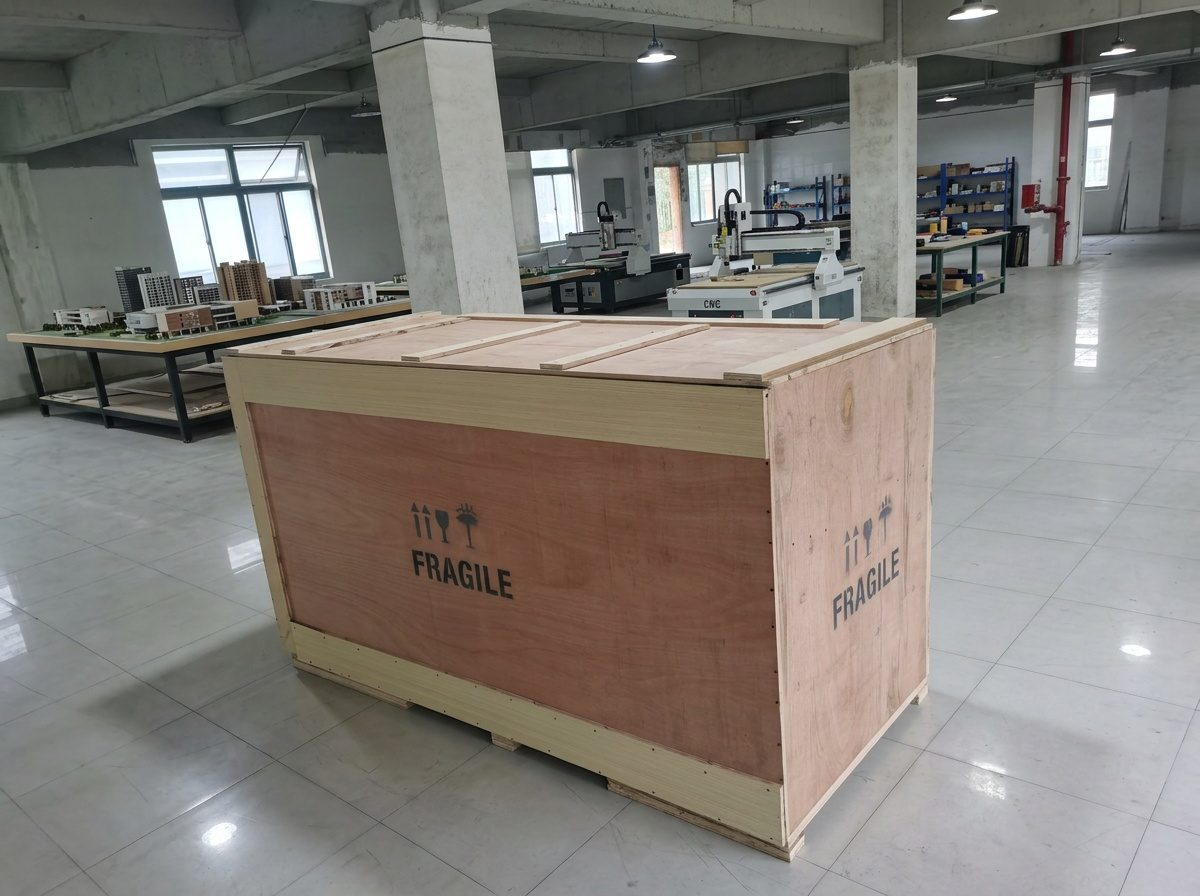
A model leaves the workshop in a plywood crate made for that model, cushioned so that nothing presses on the buildings.
Plywood is used for a practical reason as well as strength. Solid wood packaging has to be heat-treated and stamped under the international ISPM 15 rule before it may cross a border. Plywood is a processed wood and is exempt, so the crate is not held up for inspection.
Parts that would not survive the journey in place travel loose in their own packing and are fitted on site.
Who clears it
With a door-to-door courier delivery, FedEx or DHL clears the model through customs as part of the service. We prepare the invoice and the description that travel with the crate. Sometimes the courier contacts the recipient to confirm a detail. When that happens we answer it together. In our experience models pass smoothly.
Import duty and tax depend on the country of arrival. Your own customs agent or accountant can tell you what applies.
When something
is damaged
It is rare, and it happens. In 2026 one of our models arrived with damage from handling by the courier. The workshop made the affected parts again and sent them, and the model was put right.
Two habits make this simple. Photograph the crate before opening it and the model before touching it. And open the crate as soon as it arrives, not on the morning of the launch. The planner allows a week on site for exactly this.
Read next
- When to order
The commission planned back from your launch date: drawings, building, shipping and a week on site.
- Drawings, files and design changes
What the workshop needs, and until when the design can still change.
- How a commission works
From the first drawings to the crate at your door.
Built in Shanghai. Delivered to your door.