
A model of a
historical building
A historical building is hard to grasp from photographs, because no one view shows how its rooms, courtyards and roofs fit together. A scale model shows all of it at once. Built at 1:25 to 1:50, with the roof left off or the building cut away, it shows the plan, the inside and the craftsmanship of the facades, in one object a visitor can walk around.
What a model shows
that photographs cannot
Photographs show surfaces, one view at a time. Plans show the layout, but only to people who read plans. A model shows how the parts of a building fit together: the courtyard behind the gate, the rooms around it, the roof that covers them, the street it stands in.
That is why museums use them. A visitor understands in a minute what the building is, and then looks at the details. And a model does not wear: in ABS, acrylic and wood it keeps its edges and colour for decades.
Which scale
shows what
| Scale | What can be seen | Suits |
|---|---|---|
| 1:25 | Doors, fretwork, tiles, furniture, figures in traditional dress. Rooms can be furnished. | A single house or palace, especially with courtyards and interiors to show. |
| 1:50 | Brickwork, mullions, cornices and ornament, each modelled. | A facade or a building whose craftsmanship is the point. |
| 1:75 to 1:100 | The whole building and its detail together: stone surrounds, roofs, dormers. | A larger building, or a row of buildings. |
| 1:200 to 1:500 | The building in its street or its town. | A historical complex, a town centre, a site and its surroundings. |
The scale calculator shows how large the model will be at each scale.
Roofs off,
walls cut away
The inside of a historical building is often what visitors most want to see and least can. A model can show it in three ways.
Without a roof. For courtyard houses the roof is simply left off, so the plan reads from above and the courtyards are open to view. We built three courtyard houses in the Middle East this way at 1:25, among them Sadu House and Badr House in Kuwait, with figures in traditional dress in the courtyards.
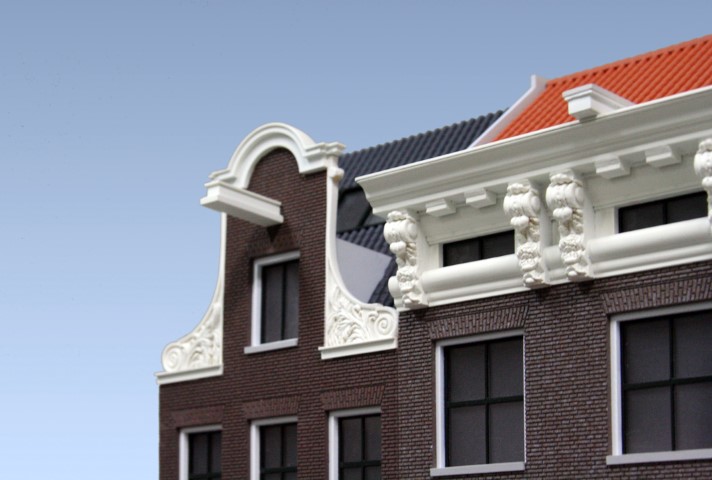
Cut away. Part of the building is cut back to show the rooms behind the facade, the stairs and the floors. The Hugo Voeten Museum model at 1:50 is cut away to show its galleries and stair.
With a lift-off roof or floor. The building is complete, but the roof or an upper floor lifts off to show what is underneath. It suits a model that is handled, for example in an education programme.


When no drawings
exist
Historical buildings often have no usable drawings, or drawings that no longer match the building. That does not stop a model.
We work from what exists: old drawings, surveys, photographs and measurements. Where levels are missing they can be drawn from aerial imagery, and where nothing has been drawn at all, the building can be photographed on site. For one commission a photographer spent four days on site recording buildings that had never been drawn. Missing drawings can be completed by the atelier and are quoted with the model.
Our guide to drawings and files lists what to send, and the document list there can be downloaded.
Before you
commission
| Question | Why it matters |
|---|---|
| Where will it stand? | A museum gallery, a visitor centre or a boardroom. It decides the size, the height of the table and whether it needs a cover. |
| Who will look at it? | Children, specialists, visitors in a hurry. It decides how much to open up and how much to explain on the plaque. |
| Which period? | The building as it is, or as it was at a chosen moment. Decide before the drawings are prepared. |
| Will it be touched? | A model that is handled needs a lift-off roof that is easy to put back, and a sturdier build. |
| Will it travel? | For an exhibition elsewhere, plan the case from the start. See a model on an exhibition stand. |
Read next
- Historical models
Heritage buildings from the archive.
- Museum models
Models built for museums and visitor centres.
- Drawings, files and design changes
What to send, and what can change while the model is built.
A building of centuries. Understood in a minute.